Monday, February 15, 2016

P is for Petrified Forest National Park

Several months ago my family seized a target of opportunity to see Petrified Forest National Park (also home to the Painted Desert) while traveling through the area.  This is a great little park and one that you can spend a couple of hours or a couple of days.  Imagine large concentrations of petrified tree trunks, badlands painted with every color of the rainbow as far as the eye can see, and a historic Route 66 road bed that still has "historic litter" like '60s-vintage soda cans.  We sampled each of those diverse areas while we were there.

We started at the Painted Desert Visitor Center right off I-40 and began our trip down the 28-mile park road, stopping at several of the overlooks.  The mixture of colors truly brings to mind a blending of impressionism on canvas!  It's no wonder they call it the Painted Desert!  This is a solid example of why I believe every area of the world has its own unique beauty to it (although Kansas may be the exception!)!


Next, just before crossing under I-40, we stopped at the historic Route 66 roadbed.  The pavement has long since been ripped out, but the short telephone poles alongside it remain.  I will say that it's not immediately obvious where the roadbed is until you realize it's the depression in the landscape.  We walked the area in both directions for a little ways looking for retro trash, which the Park Service purposefully left in place as another indicator of life on the open road 50 years ago.  While we did find a couple of pieces of rusted metal, we never found that quintessential Mello Yellow bottle.  Sadly, I think many of the neat pieces you might have once found have been claimed as souvenirs -- at least within the short distance around the parking area.


Our last stop in the Painted Desert area was Blue Mesa.  We took the hiking trail down into the valley and were amazed as the scenery just kept getting better!  A sign directed us to stay on the path, and I marveled at how fragile the landscape was in these badlands.  Even if you wanted to climb on these formations, besides damaging them, it would be very difficult as the dirt is very loose.  It was also here that we saw several petrified logs deposited during runoff from a (or the) flood.


Our last stop, near the end of the park road, was the Giant Logs trail -- a short loop trail with several large and colorful petrified logs and tree trunks on display, including a full-size petrified tree trunk that is over 10 feet tall at its base!
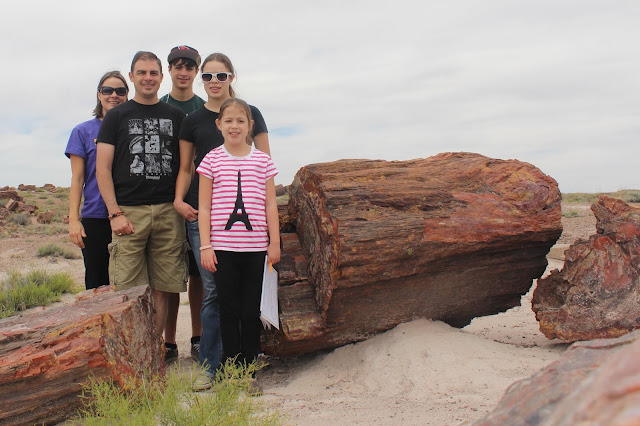


Petrified Forest National Park is a beautiful park with much to see on the park road or just a short walk off of it.  For those that want to get off the beaten path, there are also several hikes into the more remote areas of the park ranging from 2 - 8.5 miles, where you can get a more solitary appreciation for this desert artistry.  If you're headed through eastern Arizona, to or from Flagstaff, plan to make at least a short stop.

Blogging Through the Alphabet” style=

Monday, February 8, 2016

O is for Overnight Hike on the AT

As my love for outdoor adventure grew after several camping and canoeing trips, I became interested to try backpacking.  I had zero experience and zero gear, but that didn't deter me.  Back in 2008, we lived within an hour's drive of several Appalachian Trail (AT) trailheads.  I had been on the AT before, at Max Patch, along the Tennessee-Carolina border.  Max Patch is a tall bald (no trees) and standing on top of it among the grass, we felt like we were reliving the opening scene to The Sound of Music.  In that section, the AT was beautifully forested with occasional meadows and wide open vistas of the surounding countryside.


I fell in love with the trail, so I thought this would be the perfect place to try out backpacking.  When I mentioned the idea of a trip to my father-in-law, he asked if he could go with me.  So the adventure began.

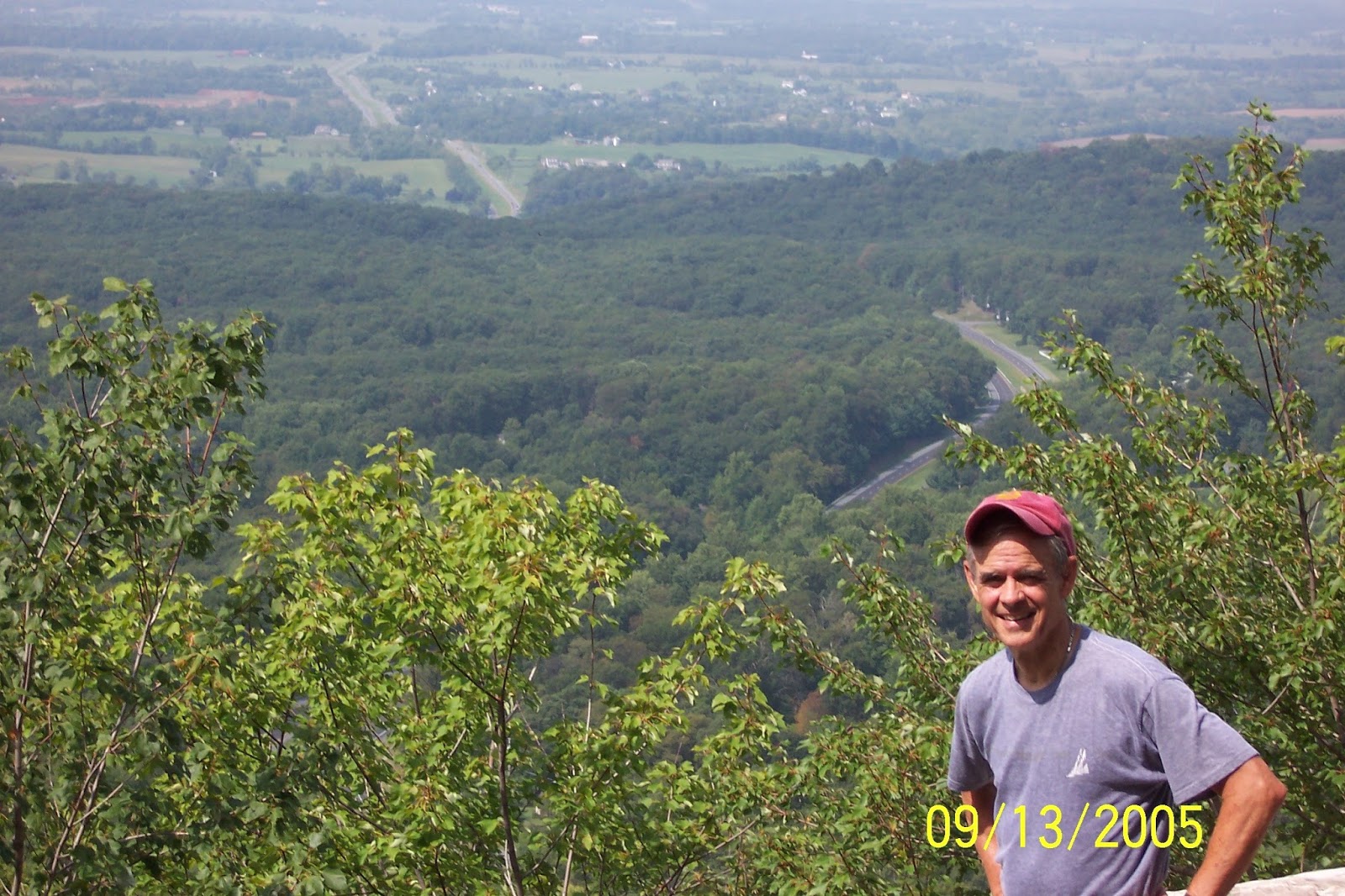
I began researching the trail in the area and found several websites with valuable information -- things like trailheads and parking, shelter locations, mileages between features, and locations of water sources.  I decided on a single-overnight trip, covering a total of about 32 miles.  We dubbed it the Three-State Plan because we would start in Virginia, travel through Harper's Ferry, West Virginia, and finish up in Maryland.

Neither of us had any backpacking gear, so we cobbled together what we could.  We rented external frame backpacks.  We each took one of my fleece sleeping bags.  It was mid-September, so we didn't expect cold weather.  We didn't have backpackable air mattresses, so we used pool rafts.  We intended to stay at one of the larger shelters along the trail, but knew we couldn't guarantee space and/or might decide to stop somewhere else, so we also took the kids' 3-man tent.  It wasn't heavy, but by backpacking standards, it was a ginormous anvil.  We didn't have bladders, so we used a couple of Gatorade bottles, and we had no trekking poles.  For clothing, I was in pretty good shape.  I was an avid runner, so I wore a moisture-wicking polyester running shirt -- the same kind I still wear frequently on my backpacking adventures.  I also had come across some convertible quick-drying hiking pants for a good price, and I had a very comfortable pair of Keen hiking boots.  For a hat, I wore my military boonie hat with a clip-on headlamp that must had a power of about 10 lumens.  It's a good thing we didn't need to do any real night hiking!  Chuck wasn't quite as well outfitted.  He wore a cotton t-shirt, blue jeans, a baseball cap, and tennis shoes.  We looked quite the pair!

We didn't have a stove either, but that was okay.  We packed MREs (military Meals Ready to Eat) for dinner because we thought, "They're vacuum-sealed and generally dehydrated, so they'll be small and light."  Boy, was that wrong!  For lunch, we packed crackers, string cheese, and Slim Jims, and breakfast was Pop Tarts.  Boy, were we living high on the hog!


We started early at Mount Weather in the middle of what has been dubbed the Roller Coaster -- a 15-mile stretch of long and continuous ups and downs over successive mountains.  We got about 7 miles of it, and that was plenty!  The long, arduous climbs yielded many great views that were worth it each time, but as we got to the end of that part, neither of us were sure we could go on.  Along the way, at a road crossing, we saw a sign indicating a convenience store a mile or so down the road.  We opted to head down there for more snacks and Gatorade.  Later that day, we passed water but opted not to tank up.  That was a mistake.  Before we got to the next water source, we were both out of water.  When we finally did reach the place, the problem was exacerbated by the water being off the trail a little ways, and we couldn't find it.  Moreover, we had to wait 30 minutes after we did find it for our purification tablets to take effect.  That is a lesson I have never forgotten!


We pulled into the Blackburn Trail Center, one of the largest shelters along the AT, in late afternoon, and we were dead tired.  In the picture below, the look on Chuck's face says it all.


We were in for a treat, though.  The Trail Center was manned, and the couple staying there was fixing dinner for any hiker that stopped in.  There were several of us there that night, including a couple of thru-hikers that started in Maine and were happy to share their tales.  We all enjoyed massive plates of spaghetti.  It seemed we just couldn't get enough, and that was much better than the MREs we had planned!


If that weren't enough, we were given the option of either sleeping on the screened-in porch or in one of the out-buildings that had bunks like a rustic cabin.  Chuck and I chose the cabin, and we had an amazing night's sleep.

We were stiff in the morning, but we ate our Pop Tarts, shouldered our packs and headed back to the trail.  This day would be exciting!  We would be crossing the bridge into Harpers Ferry at the confluence of the Potomac and Shenandoah Rivers and then on into Maryland.  We had a much easier hike through the mountains in the cool of the forest canopy.  We reached Harpers Ferry after lunch and enjoyed strolling down the historic street of old buildings toward the headquarters for the Appalachian Trail Conservancy, where we signed the hiker register.  We also seized the opportunity for a cold drink and took in the amazing view at the river confluence before heading back out on the trail.


The last part of the hike was the hardest.  We were both tired.  Chuck had given up on his blue jeans and decided to convert them into shorts.  Still, he couldn't stay cool enough, and they were soaked through by this time.  I was having my own problems due to sweat as well.  As a result, we didn't enjoy the last part as much as we would have otherwise.  This part followed the C&O Canal towpath for about three miles before jumping off.  We jumped off at that same point, ecstatic to see our car waiting for us in the trailhead parking lot.

Despite being worn out, I was hooked.  I had found a new love that I haven't abandoned to this day, some seven years later.  I learned a few lessons, though, the same ones nearly every backpacker has learned early in their journeys:

1)  Gear isn't everything.  We were able to complete a successful and extremely enjoyable overnight hike with just what we were able to cobble together with near-zero investment.  I've seen Boy Scouts do the same thing successfully.
2)  That said, having the right gear helps.  It wasn't long after that I bought my first backpack and sleeping bag, both of which I'm still using today.  Looking back, I laugh at how unprepared we were in terms of our gear.  Having better gear means a smaller, lighter pack, a better night's sleep, better food, and better comfort.
3)  Planning is everything.  If we hadn't done so much route planning in terms of where we intended to stay, where water sources were, etc., the trip would not have been nearly as enjoyable.
4)  Never pass up the opportunity to fill up on water.  The consequences could be disastrous.  If we hadn't finally found that water source, we would have been in a world of hurt.

Blogging Through the Alphabet” style=

Monday, February 1, 2016

Bent's Old Fort NHS

Bent's Old Fort preserves the history of trade and frontier life at an extremely isolated yet important outpost along the Santa Fe Trail.  It is an extremely well-done historic site with plenty of interest to adults and families alike.

Originally from Missouri but drawn to the frontier fur trade, William and Charles Bent established the fort in 1833 as a trading post in present-day southeast Colorado, along with Ceran St Vrain, a prominent Taos citizen.  It sat along the Santa Fe Trail and beside the Arkansas River, which at that time was the border between the US and Mexico.  The Bent, St Vrain, & Co. forged close ties and good trade relations with many of the plains tribes, such as the Cheyenne and Arapaho.  Thus, at the fort, they created a booming trade business of beaver, buffalo, and other furs going east (which the people used to keep warm in the winter) and, in exchange, provided many East Coast and European wares, such as beads, blankets, pots, and knives for the Indians.

It wasn't just a trading post, though.  This was THE stop along the Santa Fe Trail.  There was nothing else between Fort Leavenworth, in present-day eastern Kansas, and Santa Fe in Mexican territory.  As people made their way to the allure of a new life in the ranch land of the southwest or along the California coast, this oasis was a welcome respite of near luxury to those that had spent the last 529 miles seeing no sign of civilization save for perhaps some Indians they preferred to avoid.

Although constructed in the style of a castle or fort, in reality, Bent never intended it to be a protective outpost manned by the Army.  His goal was free and peaceful trade between all peoples in the area.


The Council Room inside the fort was where Americans (and some Canadians) met to conduct large-scale trade with trusted Indian tribes, such as the Cheyenne and Arapaho.  This room also hosted peace councils between warring tribes, seen as a neutral ground because of Bent's reputation as a fair and peaceful man throughout the various tribes.

Council Room
 For those tribes that had not earned trusted status, they could still trade but via a window outside the inner gate to the fort.

The Trade Room for less trusted tribes.  Notice the exchange window below the chandelier in the upper left of the photo.
The Trade Room for Americans, French Canadians, and those Indians allowed inside the fort.
The Store Room for Furs Going East
The Dining Room served hot meals each night, and those invited by the Bents or St Vrain were treated to white tablecloths and a free dessert of pie.  Even without the white tablecloths, however, this would have seemed quite luxurious compared to trail life.

Dining Room
The fort also housed blacksmith and carpentry shops.  These stayed busy continually, fixing wagons, replacing horseshoes, and the like.  Think of it as the first interstate garage!  Behind the fort, a corral held the horses, oxen, or other stock belonging to the visitors.

Blacksmith Shop
Carpentry Shop
Corral
While the cook, blacksmith, and carpenter all lived in small rooms beside their work areas, the upstairs contained dormitory-style housing for the payroll trappers or those visitors passing through.

Living Quarters
 Also upstairs was the billiard room, where the men met to play pool or cards while imbibing on some of Europe's finest alcohol.

Billiard Room
 In 1846, Brigadier General Stephen Watts Kearny rolled in from Fort Leavenworth with approximately 1500 personnel to consolidate his forces, rest for a few days, and decide on his next move on his march to California.  His mission was to take New Mexico and California from Mexico and set up civil governments in his wake, all while not disrupting existing trade in the area or inciting the Indians. (Piece of cake, right?)  Kearny commandeered two of the storage rooms to store his arms, ammunition, and supplies.

Army Supply Storage
It was late in the year, so Kearny ultimately decided on the southern route to Santa Fe to avoid the chance of bad weather even though that meant losing the wagons to bad terrain.  Kearny's mission was eventually fully successful, avoiding opposition in New Mexico and taking Los Angeles with the help of the Navy after losing in an arrogant assault at San Pasqual outside of San Diego.

By 1849, the growing tide of settlers and gold-seekers had disrupted the carefully nurtured trade industry with the Indians through over-grazing, significantly increased buffalo hunting, a cholera epidemic, and tension between the Indians and the newcomers.  As a result, the Cheyenne moved away, and Bent and St Vrain moved on, but they left a lasting lesson in melding diplomacy and economics with the Indian tribes at a time when most of America viewed them as hostile savages.  In a prolonged era to which we look back today through our lens of modernity and decry many national-level sins, this fort surely stands as a light in a dark time for all that we find noble about our country.

N is for New York City

New York City is one of my favorite places to visit.  There is so much to do there!  I've had the opportunity to visit four times, but, unfortunately, all of them were very short visits of 1-2 days.  That said, with some energy and a willingness to sacrifice "experiencing sites" for just "seeing" them, you can see a lot in New York in a day or two.

The first time I went, I was in college and buried myself in the travel book on the way.  By the end of the day, I think we had seen Wall Street and the New York Stock Exchange, Castle Clinton, the Statue of Liberty and Ellis Island, the World Trade Center, Central Park, the Metropolitan Museum of Art, the Empire State Building, the Flatiron Building, Times Square, Grand Central Station, eaten at a street vendor, taken the ferry to Staten Island, played the Big piano in FAO Schwarz, shopped in Macy's, strolled down 5th Avenue, and seen Phantom of the Opera.  Whew!

On subsequent visits, I've added in a few things that I missed originally, like the UN, the Brooklyn Bridge, Chinatown, and the East Side Tenement, while keeping some of the things you just can't miss on any visit, like the Statue of Liberty, Times Square, and Central Park.  Still, there are some things I can't believe I've missed in all my visits -- like Federal Hall, where Washington was inaugurated, or Gen Grant National Memorial (Grant's Tomb) -- so I guess I still need to go back!  On one visit, my family went for a weekend with a few other families that had young daughters with the primary purpose of going to the American Girl store.

Addison in front of American Girl
 I don't think I have ever seen a bigger smile on my daughter than when she first laid eyes on that store (this was back when there were only three in the entire country).  She was having fun, but this put the entire trip over the top for her!  We didn't miss anything either:  We shopped in the store and had dinner in the restaurant.  Then the girls went to the show, while the guys went to Times Square to see the Toys R Us with the ferris wheel.

Toys R Us Ferris Wheel
 Of course we saw many other sights, too.

Lower Manhattan from the Empire State Building.  If you look closely, you can see the Statue of Liberty.
Statue of Liberty
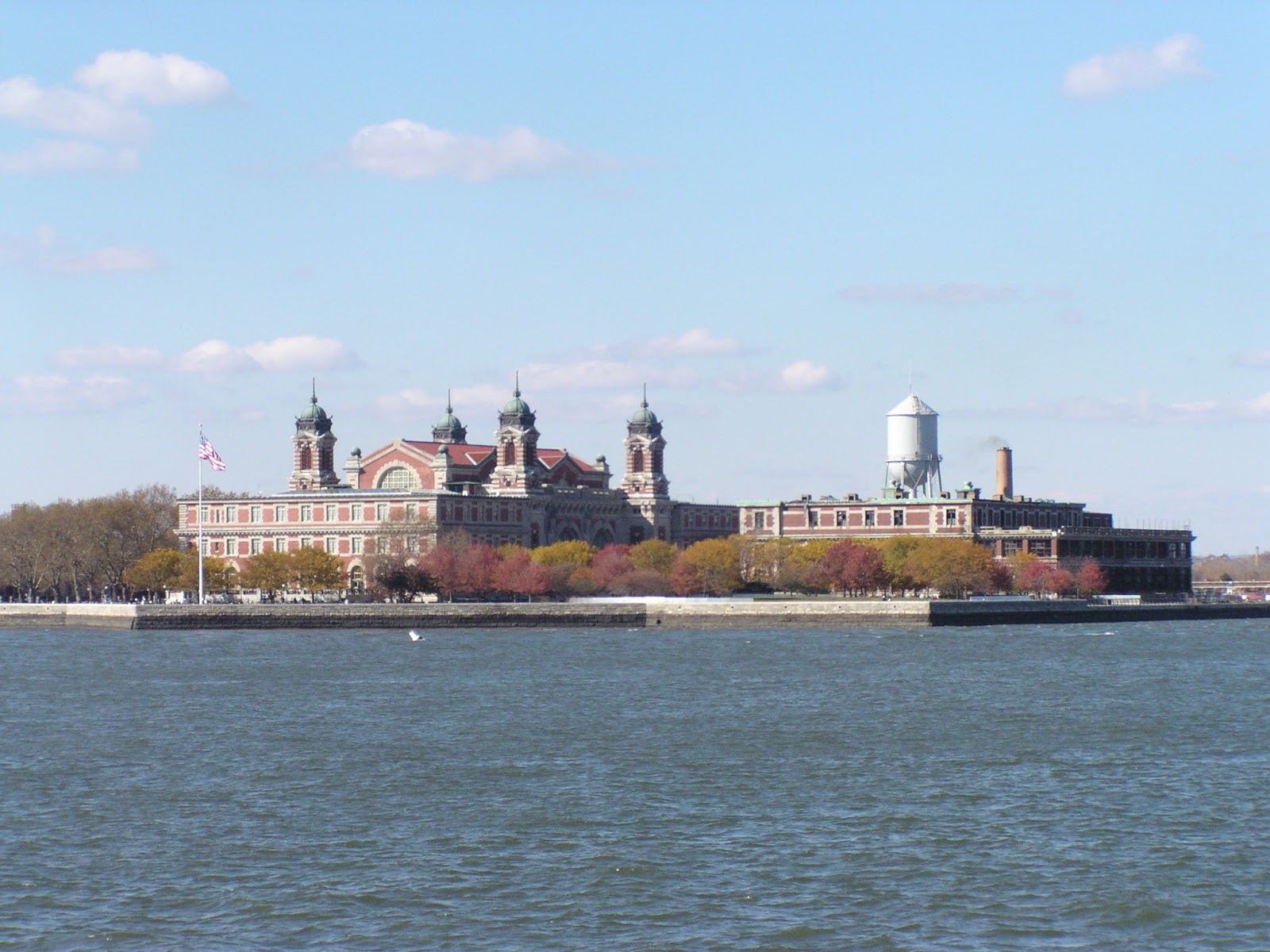
Ellis Island
Lower Manhattan from Liberty Island
Central Park
Central Park
Belvedere Castle in Central Park
Ice Skating in Central Park
Just a plain ol' playground in Central Park
FAO Schwarz
Playing the Big Piano in FAO Schwarz
Times Square
Radio City Music Hall
On my most recent trip, I had only one very short day.  Consequently, I didn't get to see nearly as much as I wanted, but I made the most of it, taking in as many sights as possible while also taking in a matinee of Newsies.  One thing on my must-see list from that trip, though, was the new World Trade Center memorial.  On my first trip, I had stood right beside it.  I even had a really neat picture of the two towers soaring above me.  My next trip was sadly after 9/11, but I visited the site because I had to see it.  This last time with the memorial in place brought a closure of sorts -- as best it can for anyone who has been there when those iconic buildings stood.  It was very well done and a must-see for anyone visiting New York.

The New World Trade Center
World Trade Center Memorial
Any trip to New York City requires planning, but if you don't have the luxury of a several-day stay, planning is absolutely essential to maximizing your experience.  Below are my top travel-planning tips:
1)  Get a travel book and make a list of the sites you most want to see with a cut-line between the can't-miss and the would-like-to attractions.
2)  Next, map them out and marry that up with a subway map so you'll know where you need to get on and off, and you can plan the most efficient route.
3)  Buy as many tickets ahead of time as possible.  Statue of Liberty/Ellis Island and Empire State Building, tickets can be purchased online.  Unfortunately, the subway does not have Internet purchasing, but if you would like to get an idea of your options, you can click here.
4)  Seeing a Broadway show is a must, but there's a huge trade-off.  If you want to maximize your time, and you know what you want to see, buy your tickets ahead of time.  If you're flexible on what you want to see, and saving money is a must, go to the TKTS ticket booth in Times Square.  You can get deeply discounted (up to 50% off) same-day tickets for many of the musicals.  The cost is standing in line when you could be sightseeing.
5)  Plan what you want to see in Central Park.  If you want to hit all the big sights, it's very doable, but you need a plan.  If you just want to say you've seen Central Park, you'll at least need an exit strategy to pick up your next sight or a subway station to get there.
6)  You can usually save a lot of money on a hotel if you're willing to stay 30+ minutes outside of the city in New Jersey and take the train in.

New York City has so much to offer.  There's something to please everyone, and it will be a memorable experience no matter how much time you have to spend, so put it on your bucket list and get there! 

Blogging Through the Alphabet” style=